
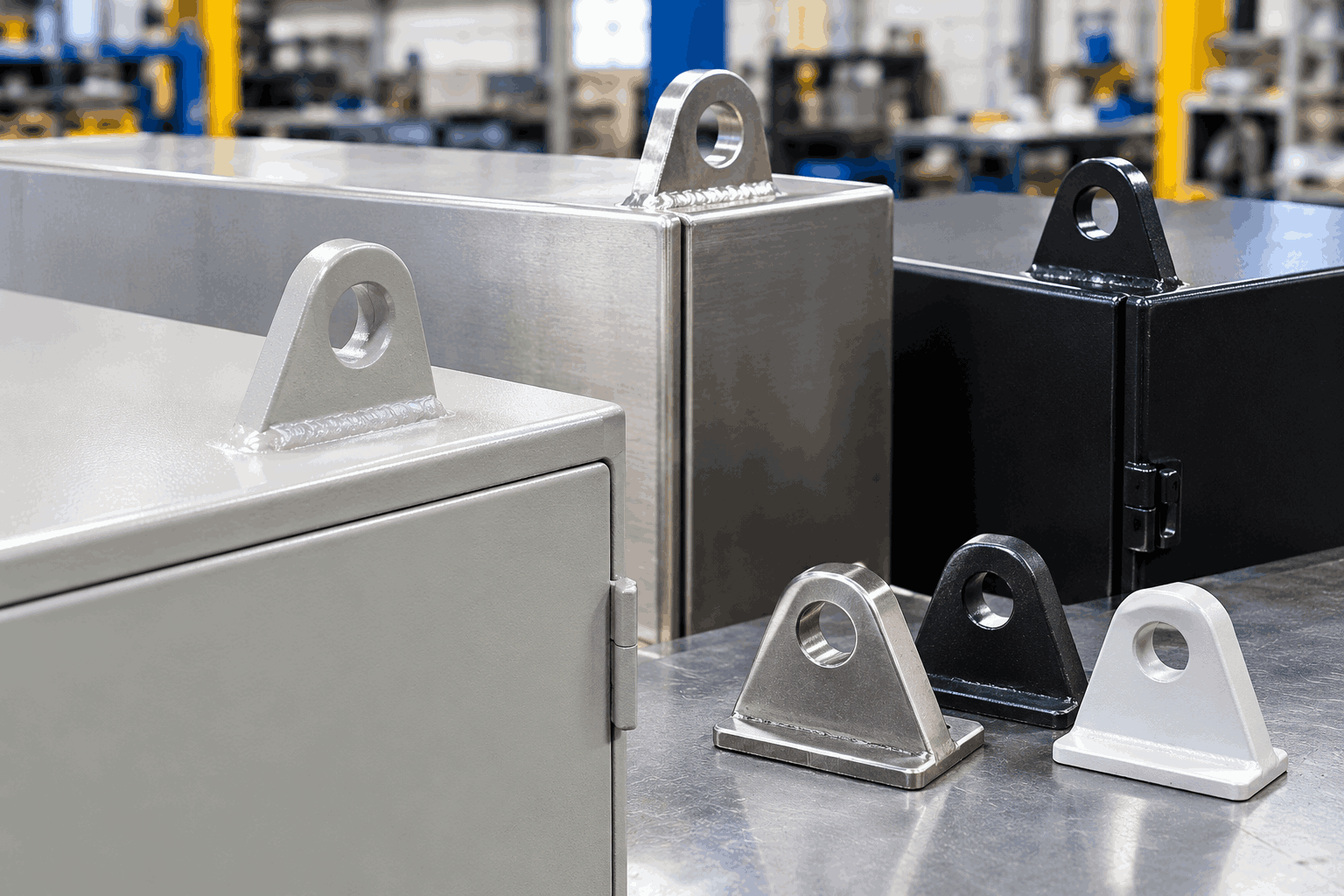
A weld-on lug rated for structural steel does not automatically translate to a control panel enclosure. The walls are sheet steel rather than plate, the tolerances are tighter, and the enclosure usually has to stay sealed and cosmetically clean after the lug goes on. None of that shows up in a capacity table.
Fabricators specifying lifting points for enclosures such as junction boxes, switchgear cabinets, and control panels work under different constraints than a structural rigging shop. Here is what changes when the lug goes on sheet metal, and what to settle before it is welded in place.
Sheet Steel Falls Under a Different Welding Code
Enclosure bodies are commonly built from 16, 14, or 12 gauge steel, roughly 0.06 in. to 0.10 in. thick. That places them under AWS D1.3, Structural Welding Code—Sheet Steel, which covers sheet 3/16 in. (5 mm) and thinner. AWS D1.1 covers the heavier structural members that most lifting lug guidance assumes.
The distinction has practical consequences. A welding procedure written for structural plate does not automatically carry over to 14-gauge sheet, where heat input, weld size, and burn-through risk behave differently. When a lug is welded to a heavier frame rail that is in turn joined to sheet, D1.3 also includes provisions for welding sheet steel to structural steel, so the joint design and the applicable code should be settled before fabrication rather than on the shop floor.
Gauge Sets the Ceiling, Not the Lug Rating
Weldable lugs are only as strong as the material they are welded to. A lug's rating describes the lug and its specified weld; it says nothing about the 14-gauge panel around it. On light-gauge skin, the sheet tends to tear or dimple at the weld toe long before the lug approaches its working load limit.
Heat compounds the problem. Sustained heat input on thin sheet visibly distorts panels, especially near seams, door openings, and gasket surfaces. Weld footprint matters here: some designs, such as the RUD weld-on pad eye lifting lug, use a compact circular fillet weld, which puts less weld metal into the part than a long rectangular base. A smaller footprint still has to land on material that can carry the load.
Reinforce the Panel Before Upsizing the Lug
On a structural rail or reinforced corner post, a weld-on eye carries load predictably. On unsupported panel skin, even a well-executed weld only moves the weak point from the lug to the sheet around it.
When the enclosure has no suitable structure where the lifting point needs to go, add local reinforcement, such as a backing plate or gusset tied into the frame, before the lug goes on. Upsizing the lug does not fix a problem that sits in the base material, and a larger lug often means a longer weld and more heat into the panel.
Welding Can Compromise the Enclosure's Rating
Enclosures are often built to a NEMA type or IP rating for dust, moisture, or washdown protection, and that rating reflects the enclosure as manufactured. Welding a lug on afterward introduces spatter, heat-damaged coating, and potential gaps at the lug base, all of which have to be cleaned and resealed to restore the original protection.
If the lug is being added to a purchased or listed enclosure, confirm with the enclosure manufacturer whether a field weld affects its rating or listing. Resolving that before welding is far cheaper than recertifying or replacing the enclosure afterward.
Stainless Enclosures Need a Stainless Welding Approach
Stainless steel lugs are common on outdoor, washdown, and corrosive-service enclosures, for the same reason stainless hardware appears elsewhere in those environments. Murphy Industrial Products, Inc. offers forged 316 stainless pad eye lifting lugs from 0.5 ton (LLS0050, 1/4 in. shackle) to 6.5 tons (LLS0650, 7/8 in. shackle), with a weld specification marked on each part.
Welding stainless sheet falls under AWS D1.6, Structural Welding Code—Stainless Steel, rather than D1.1 or D1.3. The heat-tinted zone around the weld also needs pickling, passivation, or equivalent finishing afterward. An unfinished weld on a stainless enclosure is often the first place corrosion starts, even when the surrounding sheet resists it well.
Place the Lug Before the Interior Is Built
An enclosure rarely stays empty. Wiring, terminal blocks, relays, and back panels are typically installed before or shortly after the lifting points are added. Weld heat, spatter, and the tooling needed to reach the joint all need clearance from whatever is already inside or about to be installed.
Setting locations for weld-on lugs before the internal layout is finalized avoids rerouting wiring or shielding sensitive components during late-stage welding.
Rate the Lug for the Built-Out Weight, Not the Empty Box
The weight that matters is the enclosure as it ships: wiring, components, doors, back panels, and mounted hardware included, not the bare fabricated shell. An enclosure specified against its empty weight can end up with lugs rated correctly for the box and under-rated for what actually gets lifted.
Confirm this with whoever sets the load rating, since the person welding the lug early in fabrication may never see what is added later. Once the built-out weight is known, sling angle still has to be applied to find the force on each lug; our guide to calculating the load on a pad eye or lug at different sling angles walks through that step.
Specify the Whole Enclosure, Not Just the Lug
Welded eyes for enclosures are one part of a larger decision that includes the sheet gauge, the applicable welding code, the finish, the enclosure rating, and the built-out weight. Settling those details before fabrication avoids rework on both the enclosure and the lugs.
For enclosure projects with unusual gauge, finish, or capacity requirements, contact Murphy Industrial Products, Inc. to review lug selection before welding begins.